

Sentencing Reform
Excessively harsh sentencing laws destroy families and communities. We work with lawmakers to reform mandatory minimums and sentencing guidelines, ensuring sentences serve public safety rather than undermine it.
FAMM works toward sentencing reform in these key ways:
MANDATORY MINIMUMS
FAMM is against mandatory minimums for ANY and ALL offenses.
Mandatory minimum sentences are set by Congress and state lawmakers. They require judges to impose automatic, minimum prison terms for certain offenses. One-size-fits-all sentences are not based on the individual person and do not take into account each individual’s situation.
We support repealing mandatory minimums and applying reforms prospectively and retroactively.
For further reading on mandatory minimums, visit our Policy Resource Library.

Court Cases: Mandatory Minimums
Each year, in a cycle running from October to June, the U.S. Supreme Court hears and decides criminal and civil cases. Its opinions on these important cases clarify, change, limit, or enhance existing laws and constitutional rights. The Supreme Court’s opinions bind all federal courts and sometimes even bind state courts. These legal cases sometimes include challenges to sentencing laws, including mandatory minimums.
FAMM’s work in the Supreme Court is guided by our Amicus Advisory Board. Our amicus advisory board volunteers have extensive experience practicing law in appellate courts, including the Supreme Court. Our amicus advisory board is chaired by David Debold, and includes Amy Mason Saharia, Joshua Matz, and Peter Goldberger. Both Amy and Joshua even worked for Supreme Court Justices!
Here are some recent important U.S. Supreme Court cases FAMM has been involved in:
This case involves the level of proof required, and the appropriate decision maker, to impose a 15-year mandatory minimum sentence under the Armed Career Criminal Act (ACCA). The ACCA applies to people who have been convicted of illegal possession of a firearm in the instant offense and also have at least three prior serious drug offenses or violent felonies that were “committed on occasions different from one another.” The question in Erlinger was who decides if the three priors were committed on separate occasions: a judge using the preponderance-of-the-evidence standard (a very low bar), or the jury using the much more stringent beyond-a-reasonable-doubt standard.
In a Supreme Court case from 2022, United States v. Wooden, the Court held that determining whether “occasions” are different from one another is a fact-intensive analysis. With Wooden in mind, the petitioner in Erlinger asserted that the Constitution requires a jury, rather than a judge, to make the fact-intensive finding – that the predicate crimes were committed on different occasions.
On June 21, 2024, the Supreme Court agreed with Erlinger and found the Constitution requires a unanimous jury to determine that a defendant’s past offenses were committed on separate occasions. This is huge! This means that the “occasions” finding will be subject to the “proof beyond a reasonable doubt” standard, narrowing the scope of ACCA.
Prior to this ruling, judges were able to decide whether the occasions were different from one another under the lower evidentiary standard – preponderance of the evidence. This judicial factfinding resulted in arbitrary, unreliable, and unfair 15-year mandatory minimums.
FAMM filed an amicus brief arguing that the judicial fact-finding was unconstitutional, as it took away a defendant’s right to a jury under the Fifth and Sixth amendment to the Constitution. We argued in our brief that the Framers designed the Fifth and Sixth Amendments to ensure that only a democratic body could take away a defendant’s liberties.
In addition, our brief highlighted the toll of mandatory minimum sentences under ACCA on FAMMilies. As noted in our brief, the human cost of these cases cannot be forgotten.
The changes to ACCA based on this Supreme Court opinion are unlikely to be retroactive. In other words, they will not impact peoples sentences who have already been sentenced. But this new rule will apply to ACCA cases going forward.
We are grateful to Amy Saharia, James Sasso, and Kaitlin Wetz of Williams & Connolly for authoring FAMM’s brief, which can be found here.
Many federal crimes are punishable by a mandatory minimum term of imprisonment. A court may not impose a sentence below a mandatory minimum unless Congress has authorized it to do so. The safety valve statute, 18 U.S.C. § 3553(f) is one exception. It directs sentencing judges to disregard the mandatory minimum sentence for a defendant convicted of a drug offense, so long as the person meets the safety valve eligibility criteria, which is set in law by Congress.
The First Step Act made changes to the safety valve to allow more people to be eligible for a below-mandatory-minimum sentence. Originally, a person could only be eligible for safety valve relief if they had no more than one criminal history point under the Sentencing Guidelines. The FSA increased the amount of criminal history a person could have and still be eligible for safety valve relief.
The safety valve (18 U.S.C. § 3553(f)), as amended by the FSA, directs a court to disregard a statutory minimum sentence if, among other things, the defendant does not have: more than 4 criminal history points, excluding any criminal history points resulting from a 1-point offense, as determined under the sentencing guidelines; a prior 3-point offense, as determined under the sentencing guidelines; AND a prior 2-point violent offense, as determined under the sentencing guidelines.
Circuit courts across the country disagree on whether the “and” above really means “and.” In some circuits, a defendant is eligible if they do not have all three kinds of criminal history points, (A)-(C). In those circuits a person who meets only one or two of the criteria above, are eligible for safety valve relief. Those circuits read “and” to mean “and.” Other circuits have found that if a defendant has only one or two of the criteria above, they are not eligible for the safety valve. Those circuits appear to read “and” to mean “or.”
Sometimes courts must decide what a statute means. In the criminal system, the Rule of Lenity instructs courts that when a statute is unclear it should be interpreted in a way that favors the criminal defendant. And that makes sense – you shouldn’t be punished for something that even judges can’t agree on, after all! On the issue raised in this case, federal circuit court judges across the country disagree about the meaning and implication of “and.” As such, FAMM submitted a brief arguing that lenity should rule in favor of an interpretation of the safety valve in which “and” means “and” – one which would be easier, not harder, for defendants to satisfy.
The case was argued before the Supreme Court on October 2, 2023. We are now awaiting a decision from the Supreme Court.
These cases involve a 15-year mandatory minimum that results from the Armed Career Criminal Act (ACCA). The ACCA – and the 15-year mandatory minimum sentence – applies to people who have been convicted of illegal possession of a firearm and also have at least three prior “serious drug offenses” or “violent felonies.”
Federal law has a “drug schedule” that criminalizes certain kinds and quantities of drugs. This drug schedule, however, is subject to change over time. And that is a good thing! Take, for example, our changing laws on marijuana. As such, a prior drug offense may have been committed at a time in which the drug was criminalized under federal law, but now that drug may no longer be criminalized under federal law. The question this case presents is, if the drug is no longer a crime under federal law, should the prior drug offense involving the no-longer-criminalized drug count as a “prior serious drug offense”?
FAMM filed a brief arguing that when determining whether a prior drug offense counts as an ACCA predicate, a sentencing court should look to the federal drug schedule that was in law at the time of the instant firearm offense. Congress makes changes to the drugs that are criminalized under federal law, and an individual should not be subject to a 15-year mandatory minimum, in part, based on a conviction that would no longer be a federal drug case.
This case was argued before the Supreme Court on November 27, 2023. We are now awaiting a decision.
Please note: FAMM does not provide legal advice to people going through the criminal justice system or trying to get out of prison sooner. Defendants and prisoners should speak with a federal or state public defender or a private criminal defense attorney if they need legal help or think that filing an appeal in the U.S. Supreme Court may benefit them.
REAL PEOPLE, REAL SENTENCES
Stories of the Impact of Mandatory Minimums

Kerry’s Story: Father & Friend
Kerry Weyant’s son Erik was living the nightmare that is Florida’s 10-20-Life mandatory minimum. Erik was sentenced to 20 years for firing a gun into the air to ward off attackers, even though no one was hurt.

Michael Giles: No Ordinary Defendant
Michael is a veteran serving a mandatory 25-year sentence under Florida’s 10-20-Life law after he fired two shots in self-defense, shots that did not seriously injure his attacker.

Seriously Ill and Locked Up for Stealing 6 DVDs
Too many people in Florida are serving long prison terms that don’t make communities safer. There are plenty of people locked up like Stephan Stuckey, who do not pose a risk to public safety yet languish in prison for decades, some of them seriously ill.

“A Good Man!” When Sentencing Enhancements Add 45 Years
“My roots weren’t strong, and when the storms of life came, I couldn’t hold on,” says Charles Scott, currently serving more than 51 years in federal prison – 45 of which are “stacked” mandatory enhancements.
THE FIRST STEP ACT
The Embodiment of True Criminal Justice Reform
In 2018, Congress passed the landmark First Step Act with bipartisan support, and President Donald Trump signed it into law on December 21, 2018. Now, five years later, it is clear that this important criminal justice reform legislation is an overwhelming success
However, with a presidential election on the horizon and increased social concerns with crime, the First Step Act has become an easy target for legislators and presidential candidates — with some even threatening to repeal it.
FAMM is working hard to ensure the First Step Act remains law–and that incarcerated individuals get the justice they deserve.

SECOND CHANCES IN ACTION
Stories of the First Step Act

Gerald Tarboro
My story is about two second chances. The first is mine – I got one. I spent 11 years in prison, and I was released a little early because of the First Step Act. The other one I want to tell you about is a second chance that I wish someone else could get. His name is Dawan Maynard, and he’s still behind bars, for another 17 years.

Success on the Inside: Kenny Kubinski
It may seem strange but, here’s how I look at my 24 years behind bars: Success. Hear me out. When I was convicted for my part in a marijuana drug conspiracy at the height of the war on drugs in the 1990s, there was no such thing as a second chance.
Cecilia Cardenas
The biggest misconception about former prisoners is that we’re still living the lifestyle that got us into trouble and being incarcerated. That we are dangerous. The truth is, we do not want to go back again.

Robert Shipp
“It feels like the world has given up on you. That you are just some throwaway, someone who is irredeemable.” That’s how Robert Shipp describes being sentenced to life in prison for a drug crime in 1994.
United States Sentencing Guidelines
Since 1987, the U.S. Sentencing Commission (USSC) has been writing and updating the federal sentencing guidelines, which are used when calculating sentences in federal cases. Unlike mandatory minimum sentencing laws (which are mandatory), the guidelines are advisory. In other words, judges still must calculate the guidelines to establish a sentencing range in terms of months, but a judge is free to go above or below that range. FAMM supports judges using their discretion to fashion a fair sentence for the individual being sentenced, rather than a one-size-fits-all approach (like with mandatory minimums).
The USSC proposes new guidelines for new criminal laws and issues guideline “amendments” each year that alter existing guidelines. FAMM participates in the guideline amendment process by testifying before the USSC, providing feedback and analysis of proposed changes, and meeting with USSC commissioners and staff. Since the guidelines are used to sentence over 80,000 federal offenders each year, our advocacy for more fair guidelines can have a big impact!
For further reading on the USSC, visit our Policy Resource Library.
USSC Amendment Cycles
The U.S. Sentencing Commission voted August 9, 2024 on priorities for the 2024-2025 amendment year. Rather than identify priorities, the Commission noted a common set of themes that had come up during the comment period. It intends to use those themes to guide it in identifying priorities in the coming period. Those themes are:
- Simplifying the federal Sentencing Guidelines and clarifying their role. This includes revision of the “categorical approach” for purposes of the career offender guideline and possibly amending the Guidelines Manual to address the three-step process and the use of departures and policy statements relating to specific personal characteristics;
- Reducing the costs of unnecessary incarceration;
- Promoting public safety;
- Improving community supervision;
- Expanding the Commission’s use of expertise, evidence, and best practices; and
- Promoting evidence-based approaches to offense and individual characteristics.
The Commission said it had received over 1,200 pages of ideas about guideline priorities. Many of the suggestions were very specific, including those from FAMM’s priority letter.
You can read the final themes here.
You can read other comments on the Commission’s priorities here.
In the months to come, the Commission will identify priorities and propose guideline amendments and/or studies. We will keep advocating for change and we will keep you posted on any developments. Stay tuned here!
Update: Commission declines to vote on acquitted conduct retroactivity
At its public meeting on August 8, 2024, the U.S. Sentencing Commission did not vote on whether to make the amendment ending the use of acquitted conduct in guideline calculations retroactive. The agency did not provide a reason for declining to vote, but the Chair, Judge Carlton W. Reeves, did say that “many have called for the Commission to identify clear principles that will guide its approach to retroactivity. After deep deliberation, we have decided to heed those calls.” There was no other discussion about the decision.
While this was a very disappointing outcome, the fact that there was no vote means it is possible that the Commission will revisit retroactivity at a future date.
FAMM will continue to encourage the Commission to make the acquitted conduct change retroactive.
Update: Commission considering making Acquitted Conduct Amendment retroactive.
The U.S. Sentencing Commission is seeking input on whether to make the acquitted conduct amendment retroactive. If the Commission votes to make the change retroactive, incarcerated people whose guideline range was increased based on conduct a jury acquitted them of, will have the chance to ask their judge to recalculate and reduce their sentence.
The first round of comments have been received. The Commission plans to publish those comments and then open a round for responses that will last through July 22. The Commission will also hold a public hearing in July on retroactivity of this and other amendments.
Read FAMM’s comment on retroactivity.
Read public comment on the Commission’s website.
U.S. Sentencing Commission votes to end the use of acquitted conduct.
The Sentencing Commission voted on the slate of proposed amendments to the guidelines on April 17. The top takeaway was the agency’s vote to end the use of acquitted conduct in calculating a sentencing guideline range.
Acquitted Conduct: The amendment changes the guidelines’ “relevant conduct” rule. It directs that relevant conduct (additional conduct that can be considered at sentencing) does not include conduct for which the defendant was criminally charged and acquitted in federal court. Going forward judges may not use acquitted conduct except in a couple of narrow circumstances. There may be cases in which the acquitted conduct establishes, in whole or in part, the instant offense of conviction. In such cases, the Commission states that the court is in the best position to determine whether the overlapping conduct establishes, in whole or in part, the instant offense of conviction and if so, whether it can be used. The Commission also noted that judges are also free to use acquitted conduct after calculating the guideline range, when considering whether to vary above the range.
The Commission also voted to consider making the change ending the use of acquitted conduct retroactive. The Commission staff will publish data about how many people might be entitled to retroactivity and how much their sentences might be reduced. And starting May 1, the Commission will invite people to publicly comment on retroactivity for the acquitted conduct amendment and several other amendments. The Commission will hold a public hearing on retroactivity in July.
Youthful Criminal History: The Commission did not vote to alter or end, as FAMM had urged, the use of criminal history points earned by minors. This means the criminal history rules will not change and juvenile criminal history will still be counted when calculating the guideline range.
The agency amended the policy statement on Age to recognize that one’s youth at the time of the current or any former offense might warrant a downward departure. The amendment explains that certain risk factors may affect a youthful individual’s development into the mid-20s and contribute to involvement in criminal justice systems, including environment, adverse childhood experiences, substance use, lack of educational opportunities, and familial relationships. In addition, youthful individuals generally are more impulsive, risk-seeking, and susceptible to outside influence as their brains continue to develop into young adulthood. Youthful individuals also are more amenable to rehabilitation. The age-crime curve, one of the most consistent findings in criminology, demonstrates that criminal behavior tends to decrease with age. Age appropriate interventions and other protective factors may promote desistance from crime. Accordingly, in an appropriate case, the court may consider whether a form of punishment other than imprisonment might be sufficient to meet the purposes of sentencing.
No action on guideline simplification: The Commission did not vote on the proposed amendment that aimed to simplify how sentences are calculated by eliminating the calculation of departures, one of the three steps judges currently take, and absorbing departures into a two-step process.
Other amendments: Other amendments to the guidelines included one on how loss is calculated, several on resolving circuit conflicts, and some technical amendments.
The Commission plans to send the amendments it adopted on April 17 to Congress no later than May 1. If Congress does not act to modify or amend any or all of them, they will go into effect on November 1, 2024.
Read all the amendments and the Commission’s press statement.
The U.S. Sentencing Commission began the new amendment year in June 2023, when it requested comments from the public about plans to amend the Sentencing Guidelines and study and report on aspects of sentencing. You can read about the final adopted priorities here.
On December 14, the U.S. Sentencing Commission voted to publish proposed amendments to the federal Sentencing Guidelines. Among them is one that would limit or prohibit the use of acquitted conduct. Another proposed amendment would curtail or prohibit the use of sentences imposed before the age of 18 to calculate a defendant’s criminal history score. The Commission would also expand consideration of an individual’s youthful age at sentencing. And, weighing in as probably the longest guideline amendment ever, is a proposed amendment to simplify the guidelines. These are just three examples of a number of amendments proposed by the Commission. You can read all the proposals here.
The Commission accepted public comment, including FAMM’s comment, on the proposals. It also held hearings on those proposals on March 6 and 7. FAMM member Allen Peithman testified about how unjust it was to have his sentence increased by the use of acquitted conduct and urged the Commission to end the practice.
On November 1, 2023, amendments to the federal Sentencing Guidelines went into effect. They include significant changes to the policy statement covering reduction in sentence (i.e., compassionate release), reductions in how certain criminal history is counted, and other significant and smaller changes.
Compassionate Release
The most significant changes were made to the compassionate release policy statement. The Commission added a number of new grounds for compassionate release. For example, individuals who are endangered when the BOP fails to provide adequate medical care, those who have been sexually or physically abused by BOP personnel, and those at risk of serious medical complications or death due to a public health emergency, are now eligible for reduction in sentence. In addition, people who have served at least ten years of an unusually long sentence that would be lower today based on a change in the law, may be eligible after thorough consideration of their individualized circumstances, and if the sentence they are serving is grossly disparate to the sentence they would receive today.
Read our Compassionate Release Explainer for a description of all compassionate release criteria.
Criminal History
In addition, the new guidelines reduce the use of so-called “status points.” The guidelines add two criminal history points when the “defendant committed the instant offense while under any criminal justice sentence, including probation, parole, supervised release, imprisonment, work release, or escape status.” Status points were intended to deter individuals from recidivating by increasing their calculated guideline should they do so while still involved in the system.
Status points do not serve their intended purpose. According to the Commission, status points do little to predict someone’s likelihood of being rearrested. And yet, they have a significant impact on the calculated sentence. The amendment would instead add one point if a defendant: (1) receives seven or more criminal history points and (2) committed the instant offense while under any criminal justice sentence, including probation, parole, supervised release, imprisonment, work release, or escape status. This would halve the number of status points, and limit their use to those who have significant criminal history.
Zero-Point Offenders
“Zero-point offenders” is the term given to defendants who have no criminal history points. According to the Commission’s data, people with no criminal history points are at much lower risk of recidivating when compared with people who have only one criminal history point. Yet defendants with no criminal history are treated in the same way as those with one criminal history point for purposes of calculating their guideline range.
With this difference in mind, the amended Criminal History guideline provide a two-level decrease for some defendants with zero points. To be eligible for the two-level decrease, the defendant must meet all the following criteria: the defendant did not receive any criminal history points; did not receive an adjustment for terrorism; did not use violence or credible threats of violence in connection with the offense; the offense did not result in death or serious bodily injury; the instant offense of conviction is not a sex offense; the defendant did not personally cause substantial financial hardship; did not possess, receive, purchase, transport, transfer, sell, or otherwise dispose of a firearm or other dangerous weapon (or induce another participant to do so) in connection with the offense; did not receive an aggravating role adjustment; and did not engage in a continuing criminal enterprise.
For people who receive a two-level reduction and whose offense level is not higher than 11, the amendment counsels courts to consider a sentence other than imprisonment. If an individual receives the two-level reduction but has an offense level higher than 11 and that offense level, in the court’s judgment, overstates the gravity of the offense, the court might also consider a departure to a sentence other than imprisonment.
Retroactivity of criminal history changes
On August 24, 2023, the Commission voted to make the criminal history reductions retroactive. That means that individuals who were sentenced as zero-point defendants and those who are serving sentences increased with status points can file a motion to ask the court to reduce their sentence. Defense attorneys, prosecutors, and probation officers will all evaluate motions and will identify eligible individuals.
It is estimated that more than 17,500 people will be eligible to be considered for sentence reductions of between 14 and 15 months on average.
The Commission imposed a waiting period on implementing this feature. Courts began granting criminal history retroactivity on February 1, 2024.
You can read the Commission’s research on who is applying for, receiving, or being denied retroactivity here.
The Bottom Line
The Commission made a number of changes to the federal Sentencing Guideline Manual. To see them all, visit the 2023 Guideline Manual.
Sentencing Commission Reports and Resources
The U.S. Sentencing Commission publishes a lot of data and issues reports on a wide variety of federal sentencing topics. Some of them, such as reports on how many people are being sentenced, and for what, are regularly updated. Others are one-time reports. You can find links to everything here.
Here are links to some of the research FAMM finds most helpful:
When the Sentencing Commission makes a guideline change retroactive, people who think they are eligible for a sentence reduction may ask the sentencing court to reduce their sentence. The Commission tracks how many people ask for, are granted, and denied retroactivity, and include demographic data, reasons for the denials, and a lot of other interesting information. Want to know how retroactivity is working or has worked in the past? Visit the retroactivity page.
The Commission publishes quarterly compilations of sentencing statistics, including how many people are sentenced, for what, and where. These charts also cover a variety of other useful data and trends. These quarterly reports are collected into an annual sourcebook of sentencing statistics.
You can find trends in compassionate release grants, how many motions are granted, and granular information about grounds for compassionate release and information about denials in the Commission’s reports.
Don’t want to read all those reports? The Commission has a set of quick facts. These two-pagers cover everything from women in the federal system, to drug convictions and sentences, to economic crimes and everything in between.
REPORTS & RESOURCES
Sentencing Reform Campaigns & Work
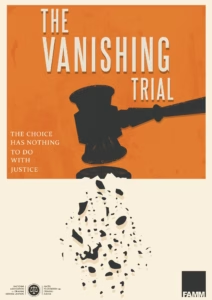
The Vanishing Trial
“The Vanishing Trial” focuses on four individuals who were forced to make that excruciating choice. Each was threatened with a “trial penalty,” the term used to describe the substantially longer prison sentence a person receives if they exercise their constitutional right to trial instead of pleading guilty. We see how the trial penalty has led to the shocking disappearance of one of the most fundamental individual rights and the explosion in America’s prison population.
Throughout the film, we hear the perspectives of national experts, including former federal judges and prosecutors, criminal defense lawyers, constitutional law experts, and criminal justice reform advocates. Watch the trailer here.